Flat Roofing in Conifer, CO
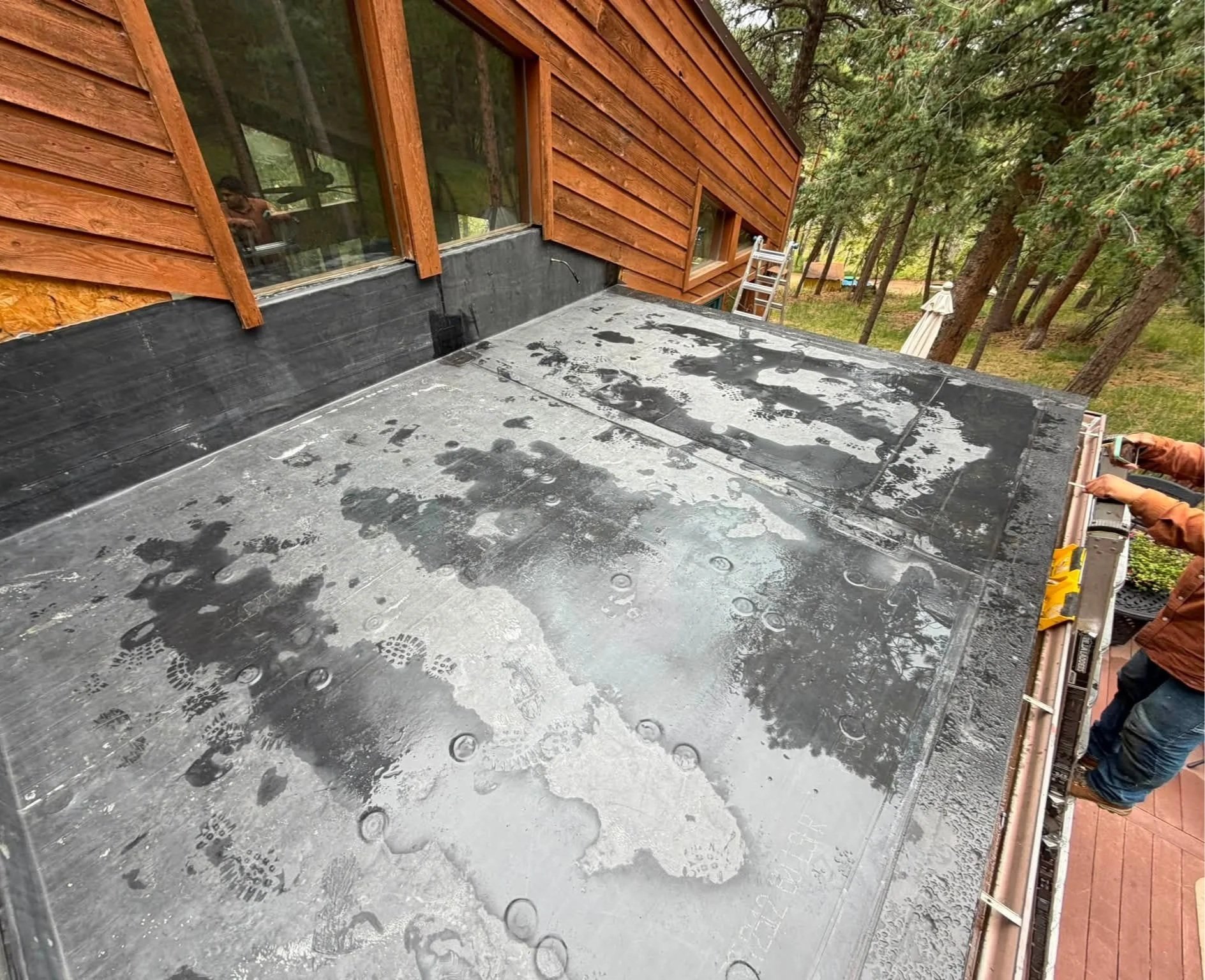
Flat roofs are common on commercial buildings, garages, additions, and some residential structures in Conifer, Colorado. Despite the name, a flat roof is rarely completely level. Most flat roofing systems are designed with a slight slope that directs water toward drains, gutters, scuppers, or other drainage points. This slope is essential because standing water can contribute to membrane deterioration, leaks, structural damage, and premature roof failure.
Unlike steep-slope roofing systems that commonly use overlapping shingles, flat roofs generally rely on continuous waterproofing membranes. The membrane creates a protective layer over the roof deck and is designed to resist water penetration across a relatively broad surface.
How Flat Roofs Work
A typical flat roofing assembly consists of several layers. The roof deck provides the structural base. Above the deck, insulation may be installed to improve energy performance and help control interior temperatures. A roofing membrane is then placed over the assembly to provide weather resistance.
Several membrane systems are commonly used. EPDM, a synthetic rubber membrane, is often installed in large sheets with seams that are sealed to create a watertight surface. TPO, or thermoplastic polyolefin, is another single-ply membrane that is commonly heat-welded at seams. PVC membranes also use heat-welded seams and are designed for durability and resistance to water and various environmental exposures.
Another method is modified bitumen roofing, which uses asphalt-based sheets reinforced with materials such as polyester or fiberglass. Built-up roofing, sometimes called BUR, uses multiple layers of roofing felt and asphalt to create a multi-ply waterproofing system.
The appropriate system depends on the building, existing roof assembly, climate, drainage design, expected traffic, budget, and other project requirements.
Flat Roof Maintenance
Maintenance is important because flat roofs depend heavily on functioning drainage and intact waterproofing. Routine inspections can identify developing problems before water enters the building or damages the roof assembly.
Drainage components require particular attention. Roof drains, scuppers, gutters, and downspouts can become blocked by leaves, dirt, sediment, and other debris. Blocked drainage can allow water to accumulate on the roof surface and increase stress on the membrane and underlying structure.
The membrane should also be inspected for punctures, cracks, blisters, loose areas, open seams, or other visible deterioration. Flashing around walls, vents, pipes, curbs, and other penetrations is another important inspection point because these transitions can create potential pathways for water.
Vegetation and accumulated debris should be removed where appropriate, while maintenance work should avoid unnecessary damage to the membrane. Mechanical equipment located on a flat roof should also be evaluated because foot traffic, tools, or equipment movement can puncture or damage roofing materials.
Flat Roof Installation
Installation begins with an assessment of the existing structure and roof design. The roof deck is inspected to determine whether it is suitable for the new system. Damaged or deteriorated decking is repaired or replaced before the roofing assembly is installed.
The surface is then prepared according to the selected roofing system. Insulation and other components may be installed as specified by the roofing design. The membrane is positioned over the prepared surface and secured using the method appropriate for the material.
Single-ply membranes may be mechanically fastened, adhered, or installed using a combination of methods. For TPO and PVC systems, seams are commonly joined using heat welding. EPDM seams can be sealed using compatible adhesives or tape systems. Modified bitumen may be adhered, mechanically fastened, or installed using an approved heat-welding method, depending on the specific product.
Flashing is installed at roof edges, walls, penetrations, curbs, drains, and other transitions. These areas receive careful attention because a flat roof's waterproofing depends on continuity throughout the entire assembly.
After installation, seams, penetrations, drainage points, and other critical areas are inspected to identify defects that could allow water intrusion.
Flat Roof Repair
Repair methods depend on the type and extent of damage. Small punctures or membrane defects may be repaired with compatible patches or materials designed for the specific roofing system. Open seams can often be cleaned, prepared, and resealed using manufacturer-approved procedures.
Flashing failures may require removal and replacement of damaged materials before new flashing is properly integrated with the existing membrane. Drainage problems may require clearing blocked components or correcting localized conditions that allow water to collect.
More extensive damage may require removal of portions of the roofing system to inspect the insulation and roof deck beneath the membrane. Wet insulation or deteriorated decking may need to be replaced before the roofing surface is restored.
A successful flat roof repair addresses the source of water intrusion rather than simply covering the visible symptom. Proper material compatibility, surface preparation, seam treatment, and attention to drainage are fundamental to both repair and installation.
When maintained and installed correctly, a flat roofing system can provide durable weather protection while accommodating the structural and architectural requirements of the building.
“We are absolutely thrilled with our newly installed roof! Dave with Troost Roofing is a true professional and he is adept in his trade.”
-Perizae T.